


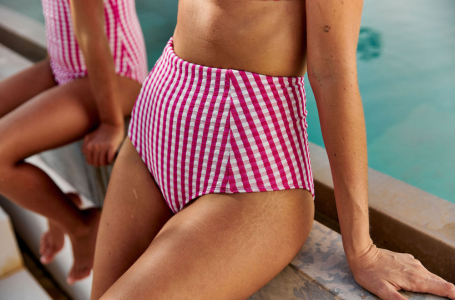
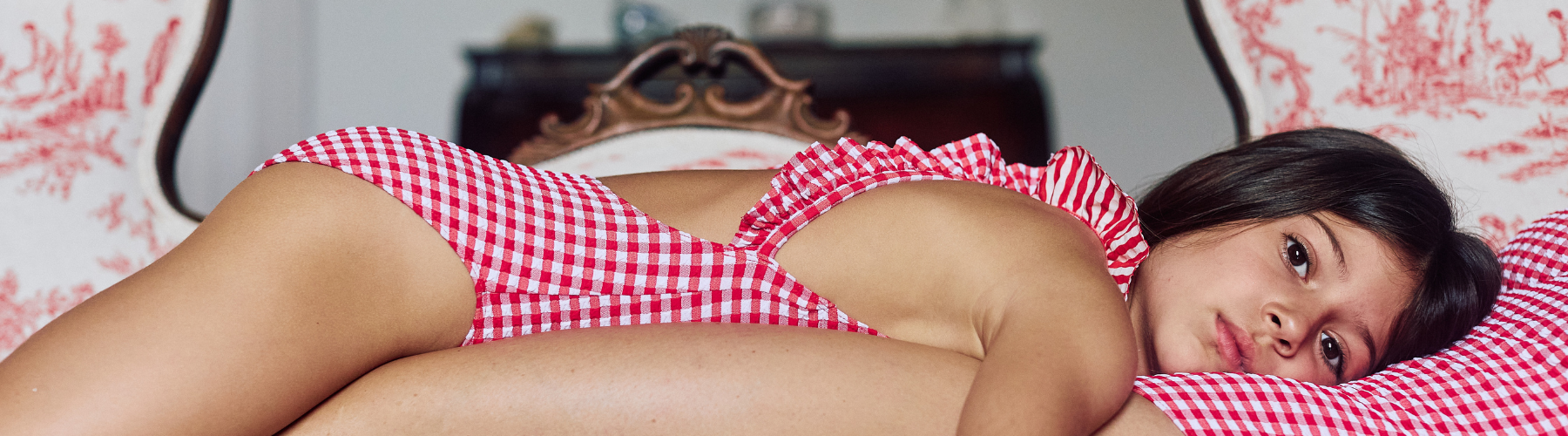
Vichy and fashion, a love story since the 19th century

|
Everyone is familiar with gingham. Before being used in fashion, the famous two-tone checkered fabric was used to make aprons, tablecloths, and napkins. For the past few seasons, it has made a major comeback on the runways. Here is the history of gingham, a fabric that never ceases to charm us.
Gingham, a simple cotton fabric
What is most appealing about gingham is its simplicity. A checkered cotton fabric, created by interlacing a white thread with a colored thread, available in many colors, and lending itself to multiple interpretations. It doesn't take much more to become a classic!
The origins of gingham
Checkered fabrics exist all over the world, but gingham is French. To find its origin, one must go back to the 19th century, under Napoleon III. At that time, the textile industry was flourishing. Spinning mills were running at full capacity to meet the needs of high society, which loved to dress in garments requiring large yardages of fabric. Emperor Napoleon III took advantage of his travels to visit textile factories. The town of Vichy, in the Allier department, was one of his vacation spots. In 1863, he took advantage of a stay in the region to visit the Grivats spinning mill, located near Vichy.
The factory had already been producing this cotton fabric for about forty years. Empress Eugénie thought the fabric would be perfect for making some pretty garments. She left with trunks full of this fresh cotton cloth, which now bears the name "vichy." For elegant women in search of something new, there was no question of missing out on this find. Very quickly, it was snapped up, both in France and abroad. But, like all trends, gingham went out of style. At the beginning of the 20th century, it returned to its utilitarian vocation in kitchens, used to make tablecloths, dish towels, aprons, and napkins.
 |
Gingham in cinema, a fabric that makes an impact
Over the last century, many actresses have contributed to the popularity of gingham. It started in 1939 with Judy Garland in The Wizard of Oz, in which she wears a delightful blue gingham pinafore dress. For the record, this dress, which was thought lost for forty years, was finally found in a box destined for the trash. After being authenticated, it was sold at auction in 2015 for the modest sum of 1.47 million euros! Not bad for a little unpretentious cotton!
Gingham has made many other forays into cinema, notably in The Philadelphia Story in 1940. Katharine Hepburn wears it in the form of a long, belted dress designed by couturier Adrian. In 1944, a very young Lauren Bacall made her film debut in a very fitted gingham suit in To Have and Have Not. A few years later, in 1959, it was dressed in a blue gingham petticoat that Brigitte Bardot swayed in Voulez-vous danser avec moi ? Ten years later, it was Jane Birkin's turn to wander nonchalantly around La Piscine in a black and white mini gingham dress.
Brigitte Bardot and gingham
One cannot talk about gingham without mentioning the most famous French star of the 60s: Brigitte Bardot. The actress contributed greatly to popularizing gingham by wearing it both in town and on screen. A love story between her and the fabric began in 1953, the year the young star appeared on the cover of Elle magazine in a pink gingham dress. She was still wearing gingham on her wedding day in 1959. The pattern for her wedding dress, designed by Jacques Esterel, was published in Elle magazine the day after the ceremony. This was the beginning of the great gingham years. French women wanted to imitate the most popular actress of the moment and, like her, have a few gingham pieces in their wardrobe.

|
Azzedine Alaïa and gingham
In the early 90s, interest in gingham had long since faded. It made a comeback through the Parisian retailer Tati and couturier Azzedine Alaïa. Since its creation in 1948, Tati's logo has been the four blue letters of its name, placed on a large-checkered pink gingham background. The designer took the large-checkered gingham and interpreted it in short jackets, capri pants, fitted skirts, and bold shorts. For the first time, haute couture mingled with a very popular brand, giving it a glamorous and trendy touch. The fashion world flocked to Tati to discover the gingham pieces from the brand-new Alaïa collection. Elle magazine dedicated a double page spread to it, mixing the designer's creations with pieces taken directly from Tati's shelves.
Gingham, more gingham, always gingham
Since then, the fresh cotton fabric has continued on its merry way, regularly making forays into fashion, notably with Versace and Alexis Mabille. More recently, with Christopher Kane, Fendi, Michael Kors..., and also with ready-to-wear brands and major retailers, Sézane and Zara, among others.